July 7, 2026 · Early Testing (Invite-Only)
TolFlow
Note: This project was formerly known as TolAnalyzer; we rebranded to TolFlow to establish a unique identity, as the previous name was too close to an existing tool in the market.
Every mechanical engineer has been there: a stack of 2D PDF drawings, a spreadsheet with manually typed dimensions, and the nagging worry that a transcription error will slip through and invalidate the entire tolerance analysis. TolFlow is the tool I'm building to fix that. It uses AI to extract GD&T callouts directly from engineering PDFs or via direct Onshape CAD import, feeding them into a collaborative 1D Worst-Case and RSS stack-up engine — bridging the gap between error-prone spreadsheets and the $25K+ 3D variation analysis suites most teams can't justify. The platform is now available for early testing by invitation.
The Development Story: From Penpot to Agentic Workflow
The journey of TolFlow started with a simple vision for the User Interface, crafted using Penpot. Through an agentic workflow, those raw design tokens and SVGs were translated into a fully functional, dynamic application interface.
Before: Penpot Design Tokens
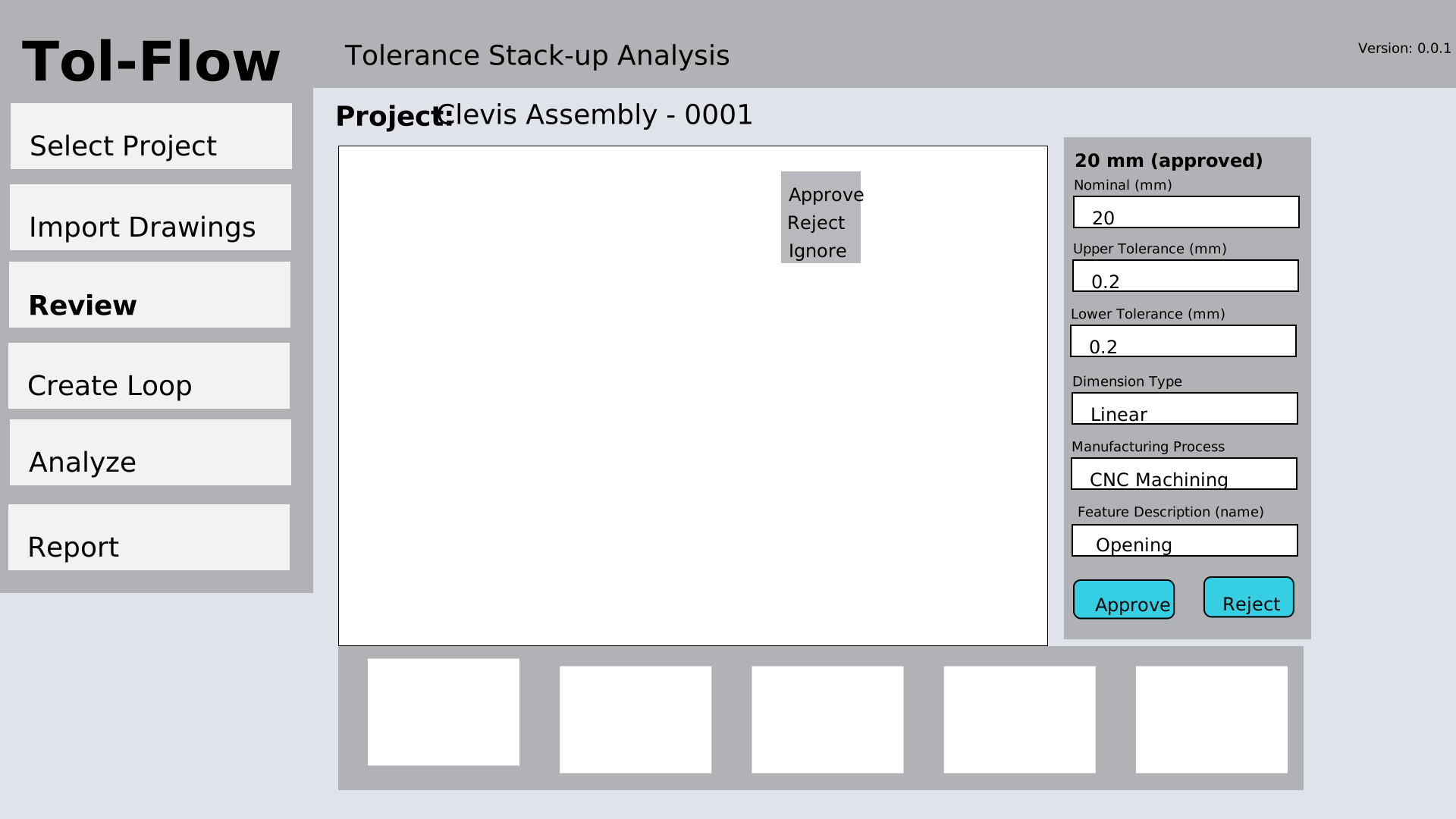
The initial static design prototype mapped out the intended workflow and visual hierarchy.
After: Live Application
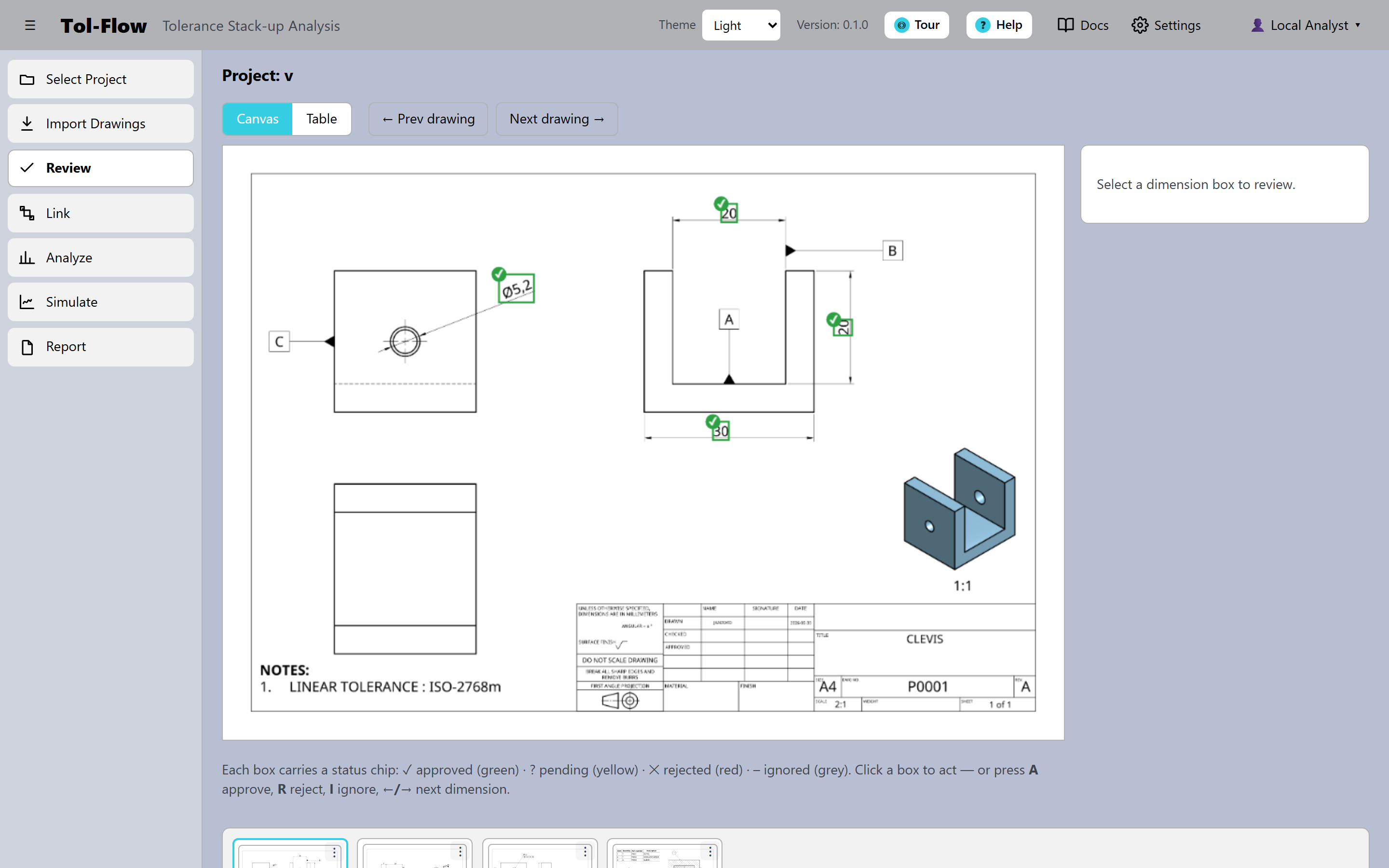
The fully functioning review interface, translating design tokens into interactive data review.
System Architecture & Security
The pipeline takes drawing data from a PDF upload or a direct Onshape import to a computed tolerance report. We recently migrated the backend from a custom CMS to a battle-tested, widely used Python framework capable of serving our Single Page Application (SPA) and multi-tenant API. Crucially, this enterprise-ready upgrade brings strict multi-tenant data isolation and argon2id password hashing for robust security.
(Visual verification)"}}:::human H --> I("🔗 Assembly Linker"):::auto I --> J("🔄 Tolerance Path Generator"):::auto J --> K("📊 Stack-Up Analysis"):::auto K --> L[/"📋 Final PDF Report"\]:::report
Tip: Pinch to zoom or scroll horizontally on mobile.
Team Collaboration & Cloud Sync
Engineering is a team sport. TolFlow has evolved beyond a single-user calculator into a collaborative, cloud-native platform.
Designer Sign-off
Instead of throwing a stack-up analysis over the wall, analysts can assign specific component drawings to the designers who own them. When a loop is built using those components, it automatically requests the designer's sign-off. Designers can review the stack, approve it, or request changes with inline comments.
Onshape Connected App
Launch TolFlow directly from an Onshape document. Drawings can be pulled in directly via OAuth2, completely bypassing the manual PDF export step. When the CAD model changes, a "Refresh from Onshape" sync updates the dimensions, seamlessly invalidating only the review states of modified geometry.
The Challenge: Why Build This?
Tolerance stack-up analysis is critical for design verification — it tells you whether your parts will actually fit and function when manufactured at the limits of their tolerances. But today, most engineers are stuck choosing between tedious manual spreadsheets and enterprise software they can't afford. TolFlow targets this "Missing Middle."
% Time Reduction
Target reduction in stack-up calculation time vs. manual spreadsheet workflows.
%+ Extraction Accuracy
Target recall on linear dimensions and basic tolerances from 2D PDFs.
$K+ Competitor Cost
Annual cost of enterprise 3D variation analysis suites like 3DCS and Vis VSA.
Development Phases
From Core Infrastructure through Ingestion, Services, Review UI, to Scanned Fallback.
Platform Interface Highlights
The system is being developed to handle everything from drawing ingestion to analytical reporting. Below are screenshots from the current live application showing key workflow steps.
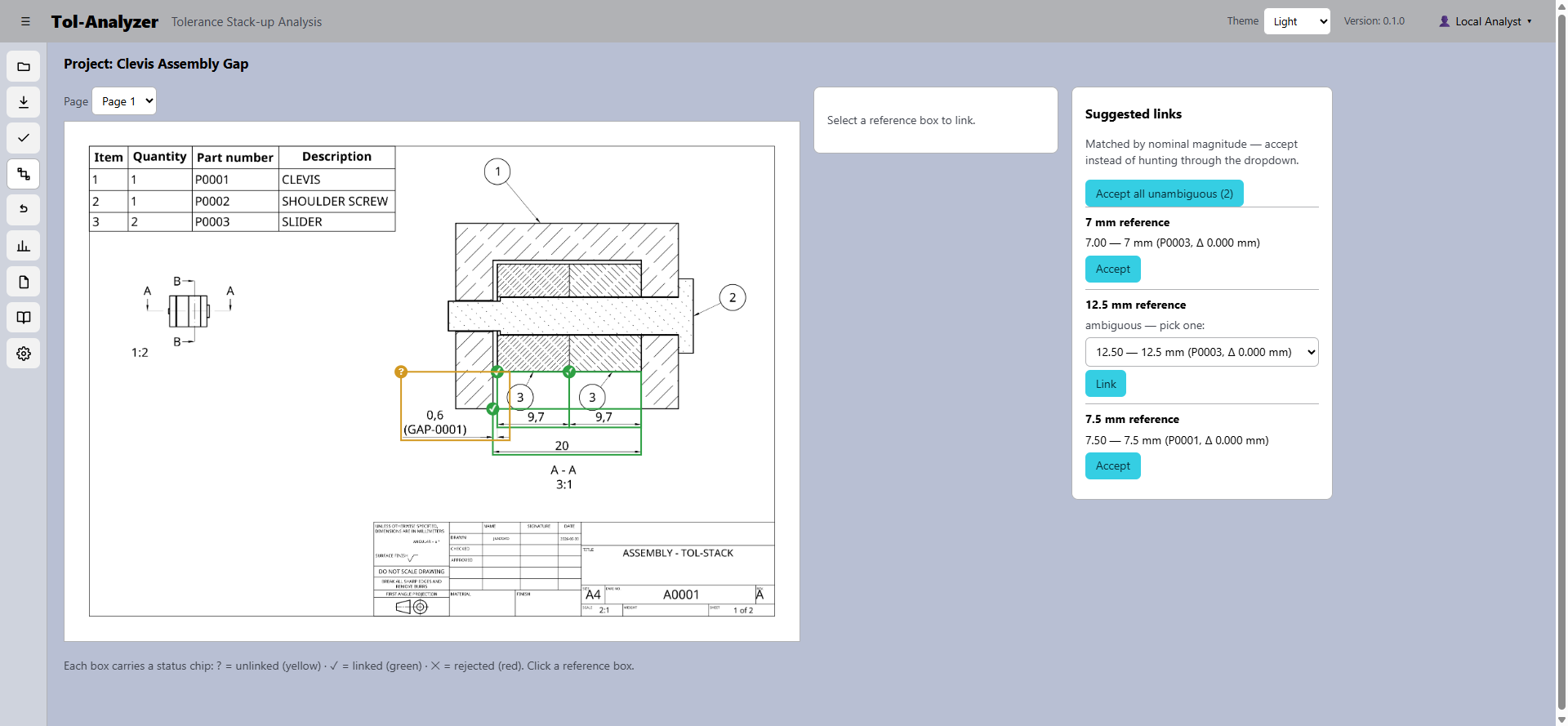
The Assembly Linker — connecting assembly views with component references and extracting reference dimensions.
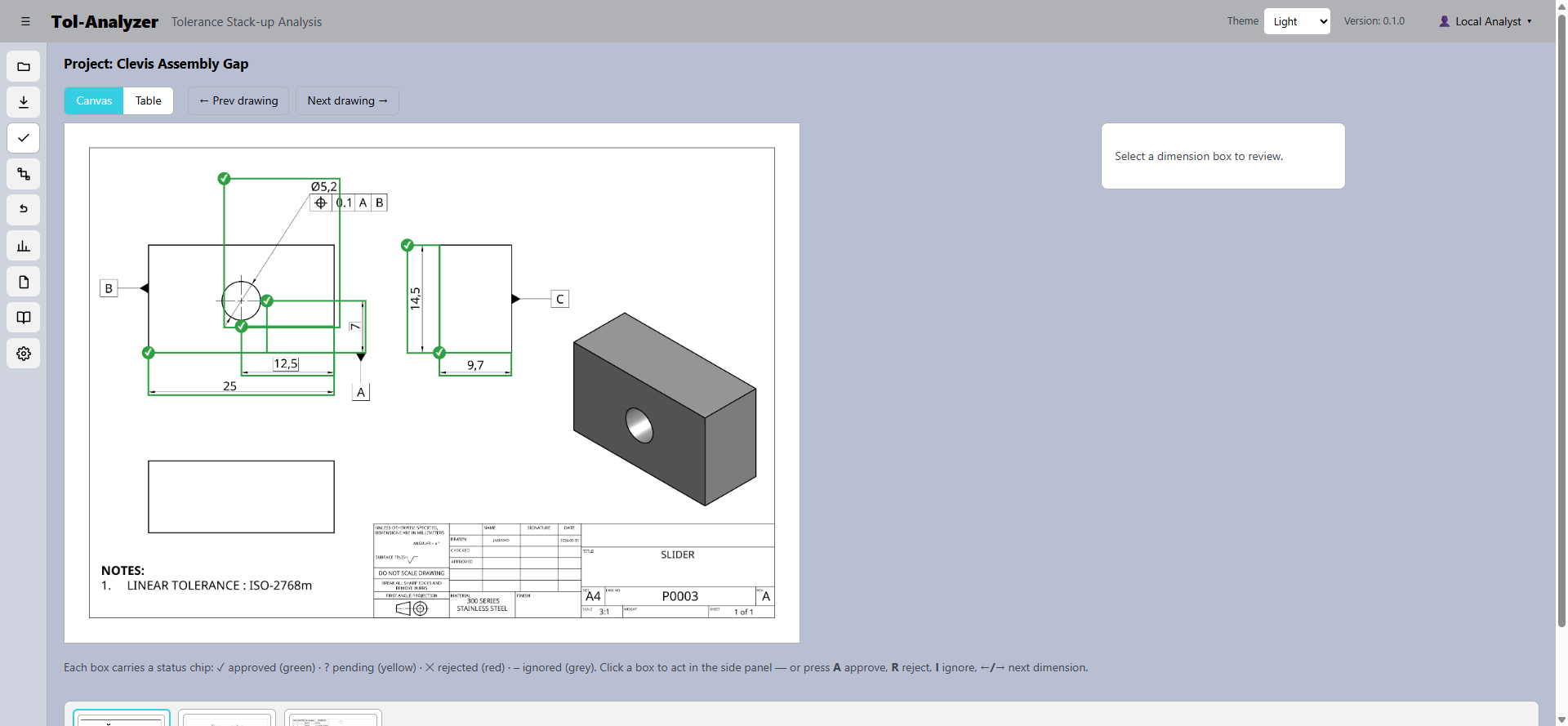
Review Canvas
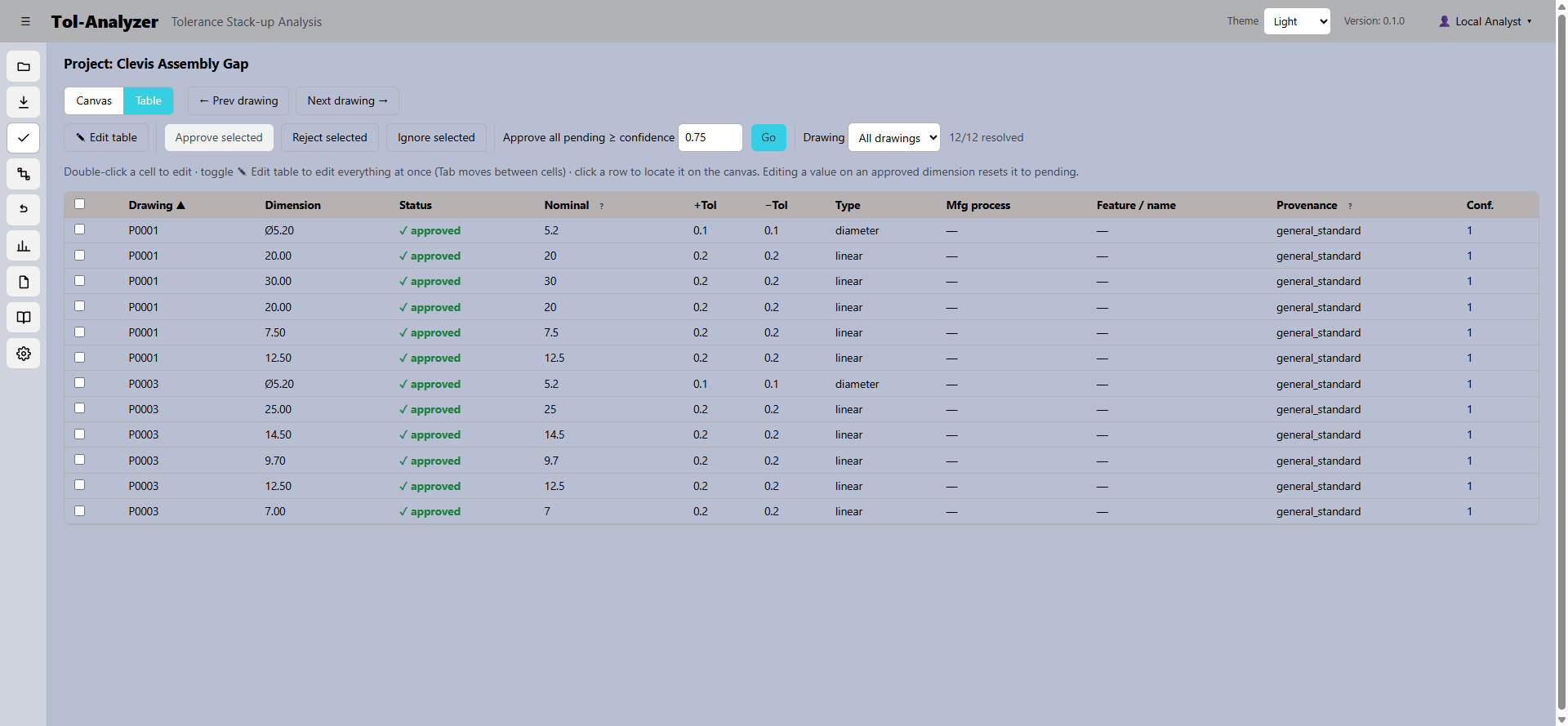
Data Table
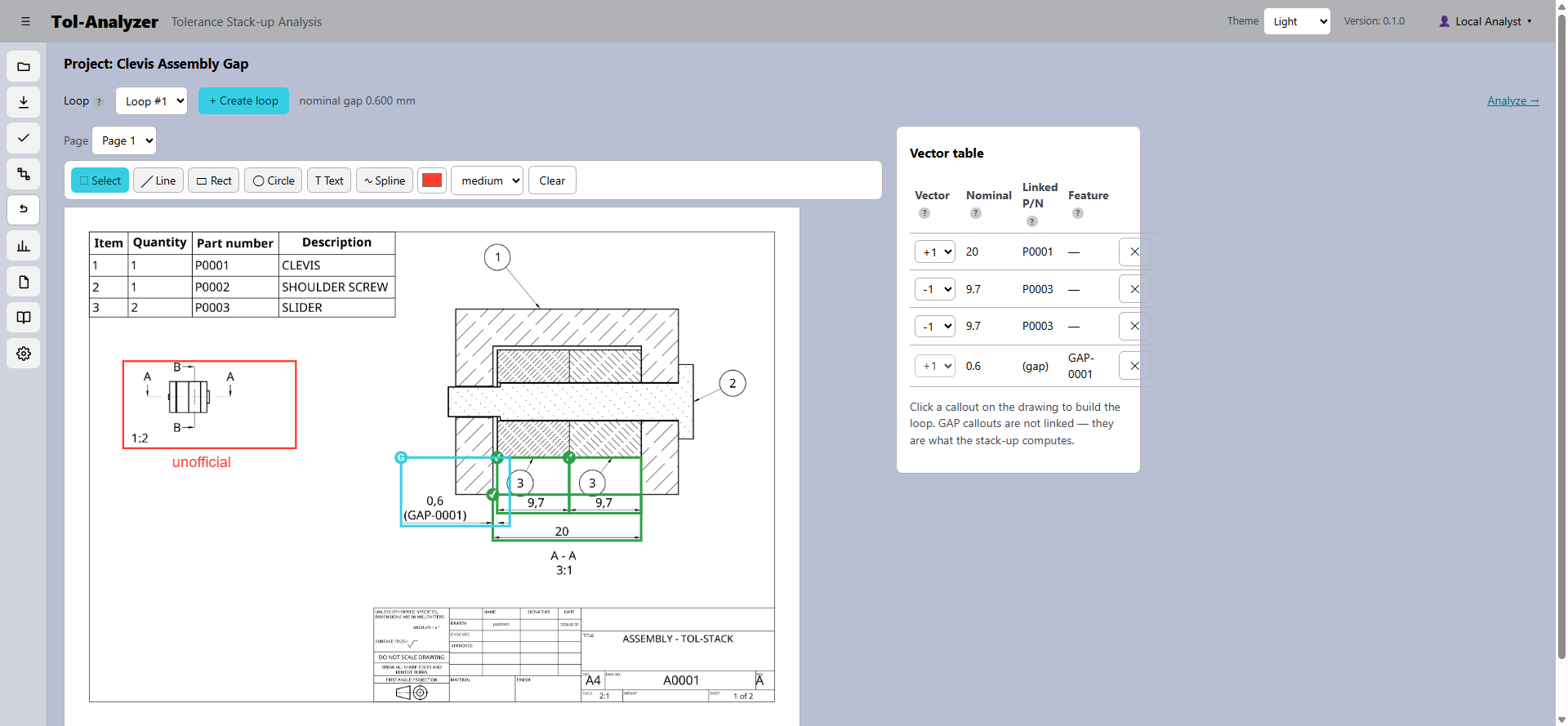
Loop Builder
End-to-End Workflow Demonstration
Watch the full TolFlow automated pipeline in action.
The Implementation: Five Phases
TolFlow is being developed incrementally. Phases 1, 2, and 3 are largely complete, delivering core stack-up engines, robust ingestion, and cloud integrations. Select a phase below to learn more.
1. Computation Engine
The math core — Worst-Case and RSS stack-up calculations with full audit trail.
2. Drawing Ingestion
Automated extraction of dimensions, tolerances, and GD&T from 2D PDF drawings.
3. Workflow Orchestration
End-to-end project lifecycle — from drawing import through loop definition to report generation.
4. Review Interface
Visual, interactive review of extracted data with human-in-the-loop approval.
5. Legacy Drawing Support
AI-assisted extraction for scanned and non-CAD drawings.
1. Computation Engine
The foundation is a standalone tolerance computation engine that performs direction-aware 1D Worst-Case and RSS stack-up calculations.
It handles the math that every mechanical engineer knows from textbooks but rarely trusts a spreadsheet to get right: properly accounting for how each dimension's direction in the loop affects whether its upper or lower tolerance widens or narrows the gap.
The engine also validates that the tolerance loop is geometrically closed — a basic sanity check that catches missing or mis-directed dimensions before they corrupt the results. All computation results are stored as immutable, checksummed records designed for regulated-industry traceability (AS9100, ISO 13485).
Technical Challenges
Building a reliable GD&T extraction pipeline surfaces edge cases that don't exist in typical document processing. Click each item to learn about the engineering challenges driving the architecture.
What's Next
With the core computation engine, drawing ingestion, and workflow orchestration largely complete, TolFlow has matured into a powerful, cloud-native collaboration tool. The platform is now available for early testing by invitation. Our next steps involve expanding the LLM-based fallback extraction for legacy scanned drawings and refining the Designer Sign-off integrations. The goal: a tool that gives every mechanical engineer access to rigorous, traceable tolerance analysis without the $25K+ price tag or the transcription errors of a spreadsheet.